Age verification

Easy2A is intended for adults. You must be 18 years or older to enter. Please confirm your age to continue.

Range Playground

Conditions in, trajectory out.

The Range Playground takes one of your own builds — every part you chose — and reads what it does downrange: where the bullet crosses your line of sight, what the day carries it by, and what the shots themselves do to the group while the trigger is down.

Free to run on any saved build · feet, yards or meters · nothing is ordered or charged from the playground

Four questions it answers

Everything in the playground exists to answer one of these about one of your own builds.

Will it hit where I aim?

Drop, the come-up the optic needs in MOA, and the drift the wind adds — read at every distance against the range your sights are zeroed at.

What is the day doing to it?

Your location sets the elevation and the temperature, so the air density is the real one; the weather and the wind dial carry the bullet off the point of aim.

What does this part change?

Barrel length and profile, muzzle device, trigger, the internals step, optic height, furniture and every accessory are counted into the reading and the rifle's weight.

How does it hold up in a string?

Barrel heat stacks shot after shot at your rate of fire, and the shots' own recoil opens the cone round by round — so a fast string is read as it really goes out.

Three steps, every time

The same short sequence whether it is your first look at a build or the twentieth time you have changed one part to see what it does.

1

Your build

Pick one of your own saved builds. The playground reads the configuration exactly as it was built: barrel length and twist, muzzle device, trigger, the parts chosen in the internals step, furniture, optic and accessories.

2

The day and the target

Type where you are shooting and the elevation and average temperature for that place are pulled in. Set the weather, drag the wind dial, and choose how far the target is and how fast the string goes out — in feet, yards or meters.

3

The reading

The path against your sights, flat where they are zeroed; drop, flight time, retained velocity, drift and holdover at every distance; the shot string on a target face; and the panels that explain what moved the group.

Trajectory and the sights

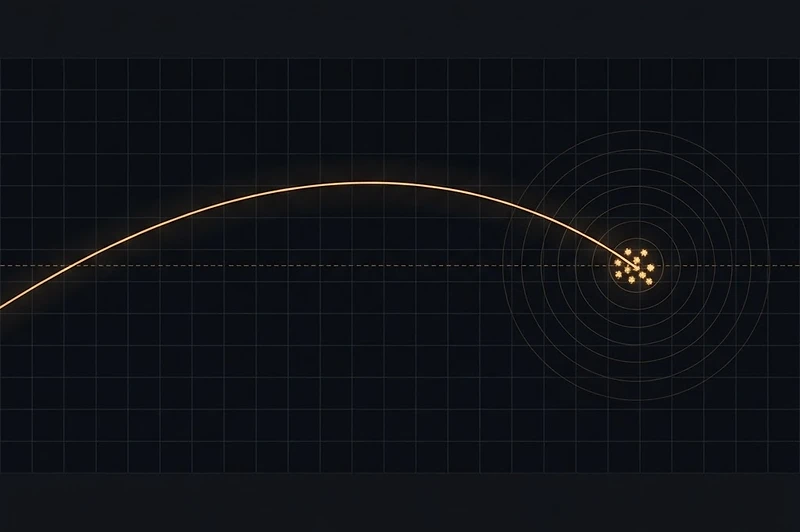
The path is read against your sights — not against a level bore.

  • Set the range the rifle is zeroed at — 100 yd, 300 m, 300 ft — and the line of sight is tilted so the bullet crosses it there. That crossing is the flat trajectory point, drawn on the chart at exactly that range.
  • Feet, yards and meters throughout: pick the unit and every distance is read in it, on that unit's own round ranges — 100–500 yd, 100–500 m, 150–1,500 ft.
  • Each distance carries velocity, flight time, drop in inches against the line of sight, wind drift, the holdover the optic needs in MOA, and the group the build prints there.
  • Drop is signed the way a shooter reads it: a minus is under the point of aim, a plus is over it, and the zero row reads nil.

The day you are shooting in

Weather is not a disclaimer in the reading — it is an input to it.

  • Your location sets the elevation above sea level and that place's average temperature, which together give the air density and the density altitude the bullet actually flies through.
  • The weather presets — sunny, overcast, rainy, snowy — stand for the temperature and humidity of that kind of day. Rain and snow add air density, which costs a little muzzle velocity as well as adding drag.
  • The wind dial sets speed and direction. The playground resolves the part blowing across the line of fire and shows how far it carries the whole group by the distance you are reading.

Ammunition and stability

The bullet is matched to the barrel it is leaving.

  • Every cartridge in the catalog carries the loads sold for it: bullet weight, length, ballistic coefficient and the velocity the load was published at.
  • Published velocity is tuned to the barrel on the build — an inch of barrel is worth a known number of feet per second in each chambering — and what an over-gassed system vents early is taken off the top.
  • Twist is checked against that bullet with the Miller stability figure: comfortably stable, marginal, over-stabilised, or unstable — where the bullet keyholes and the group opens by a factor of five, whatever else the build does.

Every part on the rifle, counted

Components are not decoration: each one changes what the group does.

  • Barrel profile matters both ways: a pencil barrel turns heat into lost accuracy fastest and whips most, while a heavy bull barrel soaks heat and holds the barrel still.
  • The muzzle device is read as what it is: a brake vents the gas that moves the rifle, a suppressor adds weight at the muzzle without venting anything, and an out-of-spec brake distorts the crown.
  • Trigger pull weight, a lightweight firing pin, and the internals step — gas system, buffer and spring, bolt lock time, barrel fitting — all reach the group.
  • Optic height above the bore, furniture, a foregrip or bipod, an offset sight and every accessory are counted into the rifle's weight — and that weight is what the shots' recoil works against.

The string of fire

A rifle does not shoot the same on round one as it does on round ten.

  • Rounds in the string and rounds per second are yours to set: a slow string sheds barrel heat between shots, a fast one stacks it shot after shot.
  • Heat left in the steel grows the dispersion as the string goes on, and it is read into the group at the end of the string — the widest the cone gets.
  • The shots themselves expand the cone too — weapon bloom: recoil energy against rifle weight, tempered by the muzzle device and the barrel's stiffness, settling between rounds at a rate the action decides, and finally held at that platform's own ceiling.

What comes out

One build, one day, one string — and figures you can act on.

  • A shot string drawn from the build itself: the same build and the same settings always draw the same group, so a change you make is the only reason the picture moves.
  • Group size in inches and MOA, mean radius, and a score on the ring target — or rounds on paper and in the black on the silhouette and the scene faces.
  • Four panels sit under the reading: the day and the wind, the rifle as configured, the string of fire, and what moved the group — every modifier that helped or hurt, with its factor shown.
  • Rifled firearms only. A shotshell is a cloud of pellets, not a single bullet, so shotguns stay in the configurator.

Built to answer a question

Tuning a build to a purpose is the whole point of running it.

  • Ask the questions that used to need a range day: what if the barrel were two inches shorter, what would a suppressor do to the holdover, will this twist stabilise the heavier bullet, how much does the wind cost me at 500.
  • Save the build from the playground when a change is worth keeping. It opens in the configurator ready to be ordered, with the parts you settled on.
  • Nothing here is a guess about your rifle: the reading is computed from your parts list, the load and the day you set — not from a table for a similar gun.

Three builds, three questions

What a session is worth depends on what the rifle is for.

A quiet, short defensive build

Short barrel · suppressor · subsonic load · heavy bullet

How much the bullet drops inside 100 yd once it is subsonic, what the suppressor's weight does to a fast string, and whether the twist still stabilises the heavy bullet.

A precision build

Long bull barrel · match load · high ballistic coefficient

Retained velocity and flight time out past 500 yd, how far the wind carries the group, and where the path is flat with the sights zeroed at 300.

A rifle that gets shot fast

Pencil barrel · five rounds a second · full magazine

How much the group opens by the last round, how long the rifle needs to settle after it, and where the platform's own ceiling stops the cone from opening further.

Take one of your builds to the range

Open a saved build, set the day, fire the string — then change one part, one load or one condition and read it again.